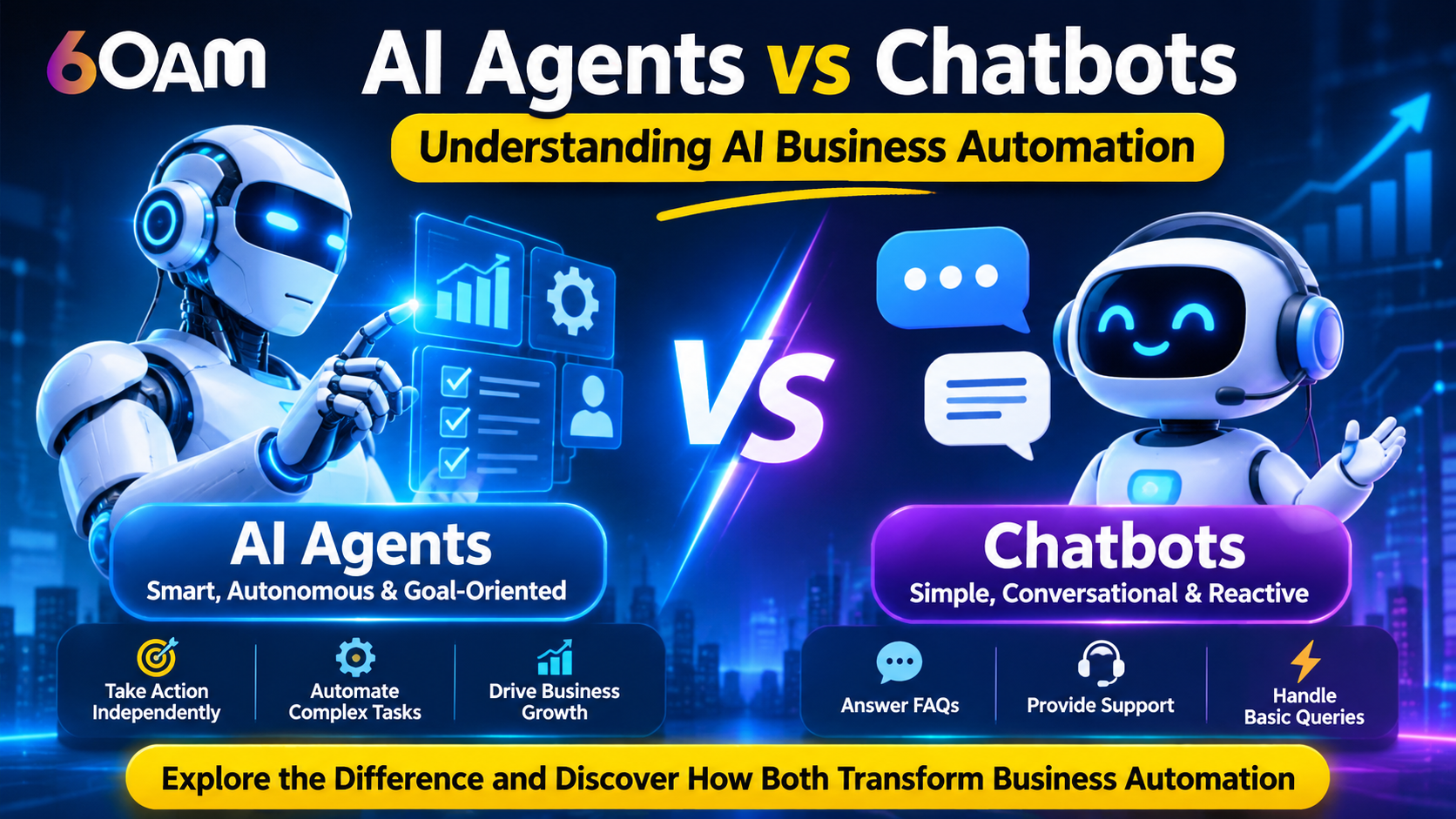
Artificial intelligence is changing how businesses communicate with customers, manage daily tasks and handle repetitive work. From answering customer questions to managing complex workflows, AI-powered technology is becoming an important part of modern business operations.
But a new question is gaining attention: Are AI Agents replacing traditional chatbots?
You may have already interacted with a chatbot on a website or WhatsApp. It answers questions, provides information and guides you through basic processes. Now imagine an AI system that can understand your request, decide what steps are needed, connect with different tools and help complete an entire task.
That is where AI Agents enter the picture.
Understanding AI Agents vs Chatbots can help businesses decide which technology is suitable for customer communication, lead generation, marketing and workflow automation.
Let’s explore how these technologies work and why businesses are paying attention to them.
What Are AI Agents?
AI Agents are AI-powered systems designed to work towards a specific goal. Instead of simply responding to a question, an AI Agent can interpret instructions, plan steps, use connected tools and perform approved actions to complete a task.
For example, imagine a customer contacts a company and asks for information about a service.
An AI Agent could be designed to:
- Understand the customer’s requirements.
- Identify the relevant service information.
- Ask questions to collect missing details.
- Check available information through connected systems.
- Create or update a lead record.
- Notify the appropriate sales representative.
- Trigger an approved follow-up workflow.
The exact capabilities depend on the AI model, integrations, permissions and workflow configuration.
In simple terms, an AI Agent is designed to help complete a task rather than only provide a conversational response.
What Is a Chatbot?
A chatbot is a software application that communicates with people through text or voice.
Businesses commonly use chatbots on websites, WhatsApp and other communication platforms to answer customer questions and provide basic assistance.
For example, a website chatbot might help visitors:
- Find business contact information.
- Understand available services.
- Get answers to frequently asked questions.
- Submit an enquiry.
- Request a callback.
- Navigate to the correct page.
Not every chatbot works in the same way. Some follow predefined rules, while AI-powered chatbots can understand natural language and generate more flexible responses.
A chatbot can also trigger actions when connected to other systems. However, simply using AI to answer questions does not automatically make it an AI Agent.
AI Agents vs Chatbots: What Is the Difference?
The biggest difference is how much work the system is designed to handle.
A chatbot is generally focused on conversations and defined interactions. An AI Agent can be designed to pursue a goal through multiple steps and approved actions.
Here is a simple comparison:
| Feature | AI Chatbots | AI Agents |
| Main purpose | Answer questions and assist users | Work towards completing defined goals |
| Interaction | Conversational | Conversational and task-oriented |
| Decision-making | Usually limited to configured responses and actions | Can select among approved actions based on context |
| Workflow | Handles defined interactions | Can coordinate multiple workflow steps |
| Integrations | Can connect with business tools | Can use connected tools to complete tasks |
| Best suited for | FAQs, enquiries and customer assistance | Multi-step tasks and business process automation |
Both technologies can work together. A chatbot can provide the customer-facing interface while an AI Agent handles more complex tasks behind the scenes.
How Do AI Agents Work?
An AI Agent generally combines an AI model, instructions, relevant business information, connected tools and permissions.
Here is a simplified explanation of how it works.
1. Understanding the Goal
The system receives an instruction or request and identifies what the user wants to accomplish.
For example, a business owner may want to organise new customer enquiries and notify the sales team.
2. Analysing Available Information
The AI Agent uses relevant information provided through approved sources, such as business documents, databases or connected applications.
This helps it understand the context of the task.
3. Planning the Required Steps
Based on the goal, the AI Agent can determine which steps are required and which available tools may help.
4. Performing Approved Actions
Depending on its configuration, it may interact with connected applications, update records, send notifications or trigger workflows.
5. Reviewing the Result
The system can check whether the required steps were completed and identify situations that need additional information or human assistance.
Importantly, AI Agents should operate with clear permissions, monitoring and human approval wherever sensitive or high-impact actions are involved.
Real-World Business Use Cases of AI Agents
AI Agents are not limited to technology companies. Businesses across different industries can explore them for suitable tasks.
Here are some practical examples.
1. AI Agents for Customer Support
Customer support teams often receive similar questions repeatedly.
An AI-powered system can understand common requests, retrieve relevant information and assist with suitable customer service workflows.
More complex issues can be transferred to a human representative with the conversation context.
2. AI Agents for Lead Generation
Businesses receive leads through websites, advertisements, social media and messaging platforms.
An AI-enabled workflow can help collect enquiry details, identify customer requirements, organise lead information and notify sales teams.
This can make lead management more structured and reduce delays in responding to potential customers.
3. AI Agents for Marketing Automation
Marketing teams manage multiple activities, including customer segmentation, campaign communication and lead follow-ups.
AI Agents can support selected marketing workflows by analysing available information, preparing content or coordinating approved actions through connected tools.
4. AI Agents for Sales Teams
Sales representatives spend time researching prospects, updating CRM records and preparing follow-up communication.
AI-powered systems can assist with these activities and help sales teams organise their work.
Human review remains important before sending sensitive or business-critical communication.
5. AI Agents for Internal Business Operations
Businesses can also explore AI Agents for internal processes such as document analysis, information retrieval, task coordination and reporting.
The right application depends on the complexity of the workflow and the systems involved.
Can AI Agents Replace Chatbots?
Not necessarily.
AI Agents and chatbots serve different purposes, and businesses do not always need to choose one over the other.
For example, a customer visiting your website may simply want to know your business hours. A chatbot can answer this question quickly.
However, if the customer wants to discuss a service, share requirements, arrange a consultation and receive a follow-up, a more advanced AI-powered workflow may be useful.
A combination of both technologies can provide a better experience:
- Chatbots handle initial conversations.
- AI-powered systems understand customer requirements.
- Connected workflows organise lead information.
- Sales representatives handle important discussions and decisions.
The best solution depends on what your customers need and what your business wants to automate.
How AI Agents Can Change the Future of Business Automation
Traditional automation generally follows predefined rules. For example, when a customer submits a form, the system sends an email notification.
AI-powered automation can add another layer of intelligence by interpreting information and supporting decisions within defined workflows.
Some emerging applications include:
Multi-Step Workflow Automation: AI systems can coordinate several connected tasks instead of handling only one isolated activity.
Personalised Customer Communication: AI can use relevant customer context to support more personalised responses.
AI-Powered Business Assistants: Employees can use AI systems to find information, prepare reports and complete selected tasks.
Connected Business Applications: AI Agents can interact with approved business tools and help coordinate activities across different systems.
As these technologies develop, businesses will need to focus not only on what AI can do but also on how it can be implemented safely and effectively.
What Should Businesses Consider Before Using AI Agents?
AI Agents offer interesting possibilities, but implementing them requires proper planning.
Before adopting this technology, consider the following:
- Identify the Right Task: Start with a repetitive or time-consuming process that has a clear business purpose.
- Check Available Integrations: Make sure the required applications and data sources can connect with the proposed solution.
- Define Permissions: Decide what information the AI system can access and which actions it is allowed to perform.
- Maintain Human Oversight: Important decisions and sensitive activities should have suitable approval processes.
- Test Before Deployment: Evaluate accuracy, workflow performance and error-handling before using the system in everyday operations.
- Measure Results: Monitor improvements in response time, workflow completion, productivity and operational efficiency.
Starting with a clearly defined use case is generally more practical than trying to automate every business activity at once.
How 6OAM Helps Businesses Explore AI and Automation
Understanding AI is the first step. The next step is identifying how it can support your actual business requirements.
6OAM offers digital growth and automation services that help businesses improve customer communication, lead management and online marketing processes.
Businesses exploring AI-powered solutions can consider:
AI & WhatsApp Bot
Use AI-powered chatbot and WhatsApp solutions to support customer communication, answer enquiries and organise conversations.
Marketing Automation
Create structured marketing workflows to support customer engagement and follow-up activities.
Web Lead Engine
Improve how your website captures visitor enquiries and turns potential customers into leads.
Sales Funnel Creation
Build organised customer journeys that guide prospects from initial interest towards a purchase decision.
These solutions can work together depending on your business requirements, available integrations and implementation goals.
Explore all 6OAM services:
- Web Lead Engine
- Marketing Automation
- Sales Funnel Creation
- AI & WhatsApp Bot
- Paid Advertising
- Lead Gen & Nurture
- Content Marketing
- Social Media
If you are exploring AI-powered customer communication, lead generation or business automation, 6OAM can help you understand the relevant digital solutions for your requirements.
Frequently Asked Questions (FAQs)
1. What is the main difference between AI Agents and Chatbots?
Chatbots primarily support conversations and defined interactions, while AI Agents can work towards completing goals through multiple steps and approved actions.
2. Are AI Agents better than chatbots?
Neither is automatically better. Chatbots are suitable for routine customer interactions, while AI Agents may be more useful for complex tasks and multi-step workflows.
3. Can AI Agents work with WhatsApp?
Yes. Depending on the platform, integrations and permissions, AI-powered systems can support WhatsApp-based customer conversations and connected business workflows.
4. Can AI Agents generate business leads?
AI Agents can support lead generation by collecting customer requirements, organising enquiry information and triggering suitable follow-up workflows.
5. Are AI Agents suitable for small businesses?
Yes. Small businesses can explore AI Agents for selected tasks such as customer support, lead management and repetitive administrative workflows.
6. Do AI Agents work without human involvement?
Not always. Their level of independence depends on how they are designed and configured. Human supervision is important for sensitive decisions and actions with business impact.
7. What is agentic AI?
Agentic AI refers to AI systems designed to pursue goals, plan steps and use available tools to complete tasks with varying levels of independence and human oversight.
8. How can a business start using AI automation?
Start by identifying a repetitive business task, defining the expected outcome and evaluating suitable AI tools or automation solutions. Test the workflow before expanding it.
Conclusion
The discussion around AI Agents vs Chatbots is about more than choosing a new technology. It is about understanding how AI can improve the way businesses communicate, manage information and complete everyday tasks.
Chatbots remain useful for customer conversations and routine assistance. AI Agents take the concept further by supporting goal-oriented, multi-step workflows through connected tools and approved actions.
Businesses that understand these differences can make better decisions about where AI fits into their operations.
If you want to explore AI chatbots, WhatsApp automation, marketing automation or lead generation solutions, start by identifying the processes where intelligent automation can make a meaningful difference.
Explore AI and digital growth solutions with 6OAM.
Contact 6OAM
Location- Delhi NCR
Mobile No.- +91 9429693950
Website- 6OAM