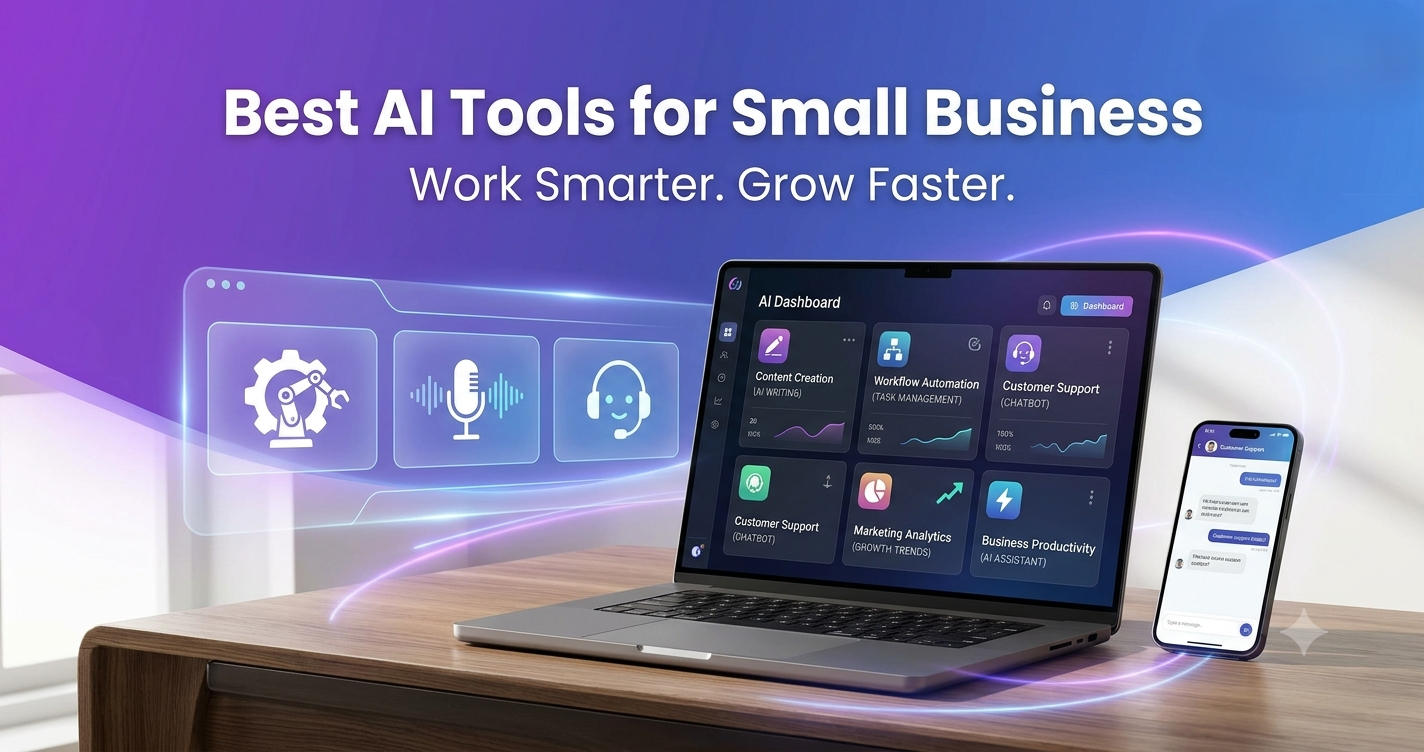
Running a small business involves managing multiple responsibilities, including marketing, customer communication, content creation, sales, and daily operations. Hiring separate professionals for every task can be expensive, especially for startups and growing businesses.
This is why many business owners are searching for the best AI tools for small business. AI-powered software can help businesses create marketing content, design graphics, automate repetitive tasks, manage customer enquiries, and improve productivity.
However, choosing the right AI software is not always easy. Some tools focus on writing, others specialize in graphic design, while some help automate business workflows or manage customer relationships.
In this guide, we compare 10 useful AI tools for small businesses, explain their features, and help you identify which solutions are worth considering for your business in 2026.
Why Are Small Businesses Investing in AI Tools?
AI tools are becoming useful for businesses that want to complete everyday tasks more efficiently.
Instead of spending hours creating content, preparing documents, answering common questions, or organizing information, businesses can use AI-powered platforms to support these activities.
Here are some common business applications:
- Creating website content and marketing copy.
- Designing social media posts and advertisements.
- Automating repetitive business workflows.
- Managing customer enquiries.
- Preparing business reports and presentations.
- Organizing customer information.
- Improving customer support.
- Researching products, markets, and competitors.
AI does not replace business strategy or human decision-making. It provides additional capabilities that can help small teams work more efficiently.
10 Best AI Tools for Small Businesses in 2026
The following tools serve different business requirements. Compare their capabilities before selecting a subscription.
1. ChatGPT – Best AI Tool for Everyday Business Tasks
ChatGPT is a general-purpose AI assistant that can support different business activities.
Small business owners can use it to generate content ideas, write emails, prepare business proposals, summarize documents, analyze information, and brainstorm marketing strategies.
Key features and uses:
- Business content and email writing.
- Research and brainstorming.
- Document and data analysis.
- Marketing ideas and campaign planning.
- Assistance with everyday business tasks.
Best for: Entrepreneurs, startups, marketers, consultants, and small business owners who need an AI assistant for multiple tasks.
Buying consideration: Compare available plans, usage limits, and business data controls before choosing a subscription.
2. Google Gemini – Best for Google Workspace Users
Google Gemini is an AI assistant that can help businesses with research, writing, brainstorming, and productivity.
Businesses already using Google’s productivity ecosystem may find Gemini useful for working with documents, emails, and other supported services.
Key features and uses:
- Writing and content assistance.
- Research and idea generation.
- Document-related productivity.
- Summarizing information.
- Support for business workflows.
Best for: Small businesses, professionals, and teams that regularly use Google tools.
Buying consideration: Check which Gemini features are included in your Google account or Workspace plan and which require separate access.
3. Claude – Best for Business Writing and Document Analysis
Claude is an AI assistant that can help with detailed writing, document analysis, summarization, and structured information.
It can be useful when businesses work with lengthy reports, proposals, research documents, or detailed content.
Key features and uses:
- Long-form content drafting.
- Document summarization.
- Business research assistance.
- Reviewing and organizing information.
- Writing and editing support.
Best for: Consultants, agencies, business writers, and professionals who frequently work with detailed documents.
Buying consideration: Compare plan limits and available features based on your expected usage.
4. Canva AI – Best for Marketing Design and Graphics
Canva is a design platform that offers AI-powered features for creating and editing visual content.
Small businesses can use it to prepare promotional graphics, social media posts, presentations, marketing materials, and other brand assets.
Key features and uses:
- AI-assisted design creation.
- Social media graphics.
- Marketing presentations.
- Image editing and background removal.
- Brand and content design.
Best for: Small businesses that want to create professional-looking marketing materials without a dedicated design team.
Buying consideration: Canva offers different plans with different design resources and AI usage allowances. Check its current pricing and feature limits before upgrading.
5. Zapier – Best for Business Workflow Automation
Zapier helps businesses connect different applications and automate workflows.
For example, when a customer submits a website enquiry, an automation workflow can send information to another connected application or trigger a notification.
Key features and uses:
- Connecting business applications.
- Automating repetitive tasks.
- Moving information between platforms.
- Trigger-based workflows.
- AI-assisted automation capabilities.
Best for: Small businesses that use multiple applications and want to reduce manual work.
Buying consideration: Review the number of tasks, connected applications, and automation features included in each plan.
6. HubSpot – Best for AI-Powered CRM and Marketing
HubSpot provides customer relationship management, marketing, sales, and customer service tools.
Businesses can use its platform to organize contacts, manage sales activities, support marketing campaigns, and explore AI-assisted workflows.
Key features and uses:
- Contact and customer management.
- Sales pipeline tracking.
- Marketing automation.
- Lead management.
- AI-supported marketing and customer service features.
Best for: Small businesses and startups that want to organize marketing and customer relationships.
Buying consideration: HubSpot has different products and subscription levels. Check which CRM, marketing, and AI features are available in your selected plan.
7. Grammarly – Best for Business Communication
Grammarly helps businesses improve written communication by checking grammar, clarity, tone, and writing quality.
It can support emails, proposals, business documents, website content, and other professional communication.
Key features and uses:
- Grammar and spelling assistance.
- Writing clarity improvements.
- Tone suggestions.
- Professional communication support.
- AI-assisted writing features.
Best for: Business owners, marketing teams, agencies, and professionals who regularly communicate with customers.
Buying consideration: Compare free and paid features, usage limits, and team requirements.
8. Notion AI – Best for Business Organization
Notion combines workspace organization, documentation, project management, and AI-assisted productivity features.
Small teams can use it to manage internal documents, meeting notes, project information, and business knowledge.
Key features and uses:
- Document creation and organization.
- Meeting notes and summaries.
- Project documentation.
- Information management.
- AI-assisted writing and search features.
Best for: Startups and small teams that want to organize projects, documents, and internal information.
Buying consideration: Check the AI features and access limits available under the current Notion plans.
9. Apollo.io – Best for B2B Sales Prospecting
Apollo.io is a sales intelligence and prospecting platform designed to help businesses identify potential B2B customers and organize outreach activities.
It can support companies that sell services or products to other businesses.
Key features and uses:
- Business contact discovery.
- Prospect search and filtering.
- Sales outreach workflows.
- Contact management.
- Sales engagement features.
Best for: B2B companies, sales teams, and agencies looking for potential business prospects.
Buying consideration: Check data availability, credits, plan restrictions, and applicable privacy requirements before purchasing.
10. AI Customer Support and Chatbot Tools – Best for Customer Enquiries
AI chatbot platforms can help businesses respond to common customer questions, collect enquiry information, and provide support outside regular working hours.
Depending on the platform, businesses can configure automated conversations for websites or supported messaging channels.
Key features and uses:
- Automated customer responses.
- Frequently asked question handling.
- Lead enquiry collection.
- Customer support automation.
- Integration with communication platforms.
Best for: Service businesses, online stores, agencies, and companies receiving frequent customer enquiries.
Buying consideration: Compare supported channels, integration options, conversation limits, and human handover capabilities.
AI Tools Comparison for Small Businesses
| AI Tool | Main Purpose | Best For |
| ChatGPT | General AI assistance | Business productivity |
| Google Gemini | AI productivity | Google users |
| Claude | Writing and analysis | Detailed documents |
| Canva AI | Graphic design | Marketing content |
| Zapier | Workflow automation | Repetitive tasks |
| HubSpot | CRM and marketing | Lead management |
| Grammarly | Writing improvement | Business communication |
| Notion AI | Workspace organization | Team productivity |
| Apollo.io | B2B prospecting | Sales teams |
| AI Chatbot Tools | Customer communication | Customer support |
Each tool solves a different problem. A business does not need to purchase all of them. Start with the activities that consume the most time or create the biggest operational challenges.
How to Choose the Best AI Software for Your Small Business
Before buying an AI subscription, consider the following factors.
1. Identify Your Business Requirements
Decide which task you want to improve.
Do you need help with content creation, customer support, sales prospecting, design, or workflow automation? Selecting a tool according to a specific requirement makes the buying decision easier.
2. Compare Free and Paid Plans
Many AI platforms offer free access with usage restrictions. Paid plans may provide additional features, higher limits, or team capabilities.
Compare the actual benefits instead of purchasing a subscription simply because it is popular.
3. Check Integration Options
Choose tools that work with your existing business applications. Integration can reduce manual data entry and make workflows more efficient.
4. Review Data Privacy and Security
Businesses should understand how their information is processed and stored.
Before purchasing, review data usage policies, privacy controls, permissions, and account security options.
5. Calculate the Return on Investment
Consider whether the subscription saves enough time or improves a business process to justify its cost.
A useful AI tool should solve a real business problem rather than add another unnecessary monthly expense.
How AI Automation Can Help Your Business Grow
Using individual AI tools is useful, but connecting them with a business workflow can provide additional value.
For example, a service-based business can create a process where:
- A visitor submits an enquiry through the website.
- The business receives the customer’s information.
- An automated system sends an acknowledgement.
- An AI chatbot responds to common questions.
- The sales team receives the enquiry for further communication.
This type of workflow can help businesses manage enquiries more systematically.
If you want to explore automated customer communication, visit 6OAM’s AI and WhatsApp Bot service.
You can also explore Marketing Automation and Lead Generation & Nurture to understand how automation can support your marketing and customer acquisition process.
Frequently Asked Questions
1. What are the best AI tools for small businesses?
Popular options include ChatGPT for general business assistance, Canva AI for design, Zapier for workflow automation, HubSpot for CRM and marketing, and Google Gemini for productivity. The best choice depends on your requirements.
2. Are there free AI tools for small businesses?
Yes. Several platforms offer free plans or limited free access. Examples include ChatGPT, Google Gemini, Canva, and HubSpot’s free tools. Features and usage limits vary, so check the official plan details.
3. Which AI tool is best for business marketing?
Canva AI can help with visual marketing, ChatGPT and Claude can support content creation, and HubSpot offers CRM and marketing capabilities. Businesses can choose based on their marketing activities.
4. Can AI tools help small businesses get more customers?
AI tools can support marketing content, customer communication, prospect research, and lead management. However, getting customers also depends on the quality of your products, marketing strategy, audience targeting, and sales process.
5. How much do AI tools cost for small businesses?
Costs vary depending on the provider, subscription plan, usage limits, and features. Some platforms offer free access, while advanced business features may require paid subscriptions.
6. Which AI tools are best for automating business tasks?
Zapier is useful for connecting applications and automating workflows. CRM and marketing platforms such as HubSpot can also support business automation depending on the selected plan.
7. Are AI tools suitable for startups?
Yes. Startups can use AI tools for content creation, research, customer communication, design, and workflow management. Starting with a few tools that solve immediate business problems is often more practical than purchasing multiple subscriptions.
Conclusion
The best AI tools for small business are the ones that solve your actual business challenges. Whether you need better marketing content, automated workflows, customer support, or sales prospecting, there are AI-powered platforms available for different requirements.
Before purchasing, compare features, subscription costs, integrations, usage limits, and data privacy policies. Start with one or two tools, evaluate their results, and expand your technology stack as your business grows.
If you want to improve customer communication and explore AI-powered business automation, discover the solutions offered by 6OAM.
Contact 6OAM
Delhi NCR
+91 9429693950
au@6oam.com
10 Best AI Tools for Small Businesses in 2026
Running a small business involves managing multiple responsibilities, including marketing, customer communication, content creation, sales, and daily operations. Hiring separate professionals for every task can be expensive, especially for startups and growing businesses.
This is why many business owners are searching for the best AI tools for small business. AI-powered software can help businesses create marketing content, design graphics, automate repetitive tasks, manage customer enquiries, and improve productivity.
However, choosing the right AI software is not always easy. Some tools focus on writing, others specialize in graphic design, while some help automate business workflows or manage customer relationships.
In this guide, we compare 10 useful AI tools for small businesses, explain their features, and help you identify which solutions are worth considering for your business in 2026.
Why Are Small Businesses Investing in AI Tools?
AI tools are becoming useful for businesses that want to complete everyday tasks more efficiently.
Instead of spending hours creating content, preparing documents, answering common questions, or organizing information, businesses can use AI-powered platforms to support these activities.
Here are some common business applications:
- Creating website content and marketing copy.
- Designing social media posts and advertisements.
- Automating repetitive business workflows.
- Managing customer enquiries.
- Preparing business reports and presentations.
- Organizing customer information.
- Improving customer support.
- Researching products, markets, and competitors.
AI does not replace business strategy or human decision-making. It provides additional capabilities that can help small teams work more efficiently.
10 Best AI Tools for Small Businesses in 2026
The following tools serve different business requirements. Compare their capabilities before selecting a subscription.
1. ChatGPT – Best AI Tool for Everyday Business Tasks
ChatGPT is a general-purpose AI assistant that can support different business activities.
Small business owners can use it to generate content ideas, write emails, prepare business proposals, summarize documents, analyze information, and brainstorm marketing strategies.
Key features and uses:
- Business content and email writing.
- Research and brainstorming.
- Document and data analysis.
- Marketing ideas and campaign planning.
- Assistance with everyday business tasks.
Best for: Entrepreneurs, startups, marketers, consultants, and small business owners who need an AI assistant for multiple tasks.
Buying consideration: Compare available plans, usage limits, and business data controls before choosing a subscription.
2. Google Gemini – Best for Google Workspace Users
Google Gemini is an AI assistant that can help businesses with research, writing, brainstorming, and productivity.
Businesses already using Google’s productivity ecosystem may find Gemini useful for working with documents, emails, and other supported services.
Key features and uses:
- Writing and content assistance.
- Research and idea generation.
- Document-related productivity.
- Summarizing information.
- Support for business workflows.
Best for: Small businesses, professionals, and teams that regularly use Google tools.
Buying consideration: Check which Gemini features are included in your Google account or Workspace plan and which require separate access.
3. Claude – Best for Business Writing and Document Analysis
Claude is an AI assistant that can help with detailed writing, document analysis, summarization, and structured information.
It can be useful when businesses work with lengthy reports, proposals, research documents, or detailed content.
Key features and uses:
- Long-form content drafting.
- Document summarization.
- Business research assistance.
- Reviewing and organizing information.
- Writing and editing support.
Best for: Consultants, agencies, business writers, and professionals who frequently work with detailed documents.
Buying consideration: Compare plan limits and available features based on your expected usage.
4. Canva AI – Best for Marketing Design and Graphics
Canva is a design platform that offers AI-powered features for creating and editing visual content.
Small businesses can use it to prepare promotional graphics, social media posts, presentations, marketing materials, and other brand assets.
Key features and uses:
- AI-assisted design creation.
- Social media graphics.
- Marketing presentations.
- Image editing and background removal.
- Brand and content design.
Best for: Small businesses that want to create professional-looking marketing materials without a dedicated design team.
Buying consideration: Canva offers different plans with different design resources and AI usage allowances. Check its current pricing and feature limits before upgrading.
5. Zapier – Best for Business Workflow Automation
Zapier helps businesses connect different applications and automate workflows.
For example, when a customer submits a website enquiry, an automation workflow can send information to another connected application or trigger a notification.
Key features and uses:
- Connecting business applications.
- Automating repetitive tasks.
- Moving information between platforms.
- Trigger-based workflows.
- AI-assisted automation capabilities.
Best for: Small businesses that use multiple applications and want to reduce manual work.
Buying consideration: Review the number of tasks, connected applications, and automation features included in each plan.
6. HubSpot – Best for AI-Powered CRM and Marketing
HubSpot provides customer relationship management, marketing, sales, and customer service tools.
Businesses can use its platform to organize contacts, manage sales activities, support marketing campaigns, and explore AI-assisted workflows.
Key features and uses:
- Contact and customer management.
- Sales pipeline tracking.
- Marketing automation.
- Lead management.
- AI-supported marketing and customer service features.
Best for: Small businesses and startups that want to organize marketing and customer relationships.
Buying consideration: HubSpot has different products and subscription levels. Check which CRM, marketing, and AI features are available in your selected plan.
7. Grammarly – Best for Business Communication
Grammarly helps businesses improve written communication by checking grammar, clarity, tone, and writing quality.
It can support emails, proposals, business documents, website content, and other professional communication.
Key features and uses:
- Grammar and spelling assistance.
- Writing clarity improvements.
- Tone suggestions.
- Professional communication support.
- AI-assisted writing features.
Best for: Business owners, marketing teams, agencies, and professionals who regularly communicate with customers.
Buying consideration: Compare free and paid features, usage limits, and team requirements.
8. Notion AI – Best for Business Organization
Notion combines workspace organization, documentation, project management, and AI-assisted productivity features.
Small teams can use it to manage internal documents, meeting notes, project information, and business knowledge.
Key features and uses:
- Document creation and organization.
- Meeting notes and summaries.
- Project documentation.
- Information management.
- AI-assisted writing and search features.
Best for: Startups and small teams that want to organize projects, documents, and internal information.
Buying consideration: Check the AI features and access limits available under the current Notion plans.
9. Apollo.io – Best for B2B Sales Prospecting
Apollo.io is a sales intelligence and prospecting platform designed to help businesses identify potential B2B customers and organize outreach activities.
It can support companies that sell services or products to other businesses.
Key features and uses:
- Business contact discovery.
- Prospect search and filtering.
- Sales outreach workflows.
- Contact management.
- Sales engagement features.
Best for: B2B companies, sales teams, and agencies looking for potential business prospects.
Buying consideration: Check data availability, credits, plan restrictions, and applicable privacy requirements before purchasing.
10. AI Customer Support and Chatbot Tools – Best for Customer Enquiries
AI chatbot platforms can help businesses respond to common customer questions, collect enquiry information, and provide support outside regular working hours.
Depending on the platform, businesses can configure automated conversations for websites or supported messaging channels.
Key features and uses:
- Automated customer responses.
- Frequently asked question handling.
- Lead enquiry collection.
- Customer support automation.
- Integration with communication platforms.
Best for: Service businesses, online stores, agencies, and companies receiving frequent customer enquiries.
Buying consideration: Compare supported channels, integration options, conversation limits, and human handover capabilities.
AI Tools Comparison for Small Businesses
| AI Tool | Main Purpose | Best For |
| ChatGPT | General AI assistance | Business productivity |
| Google Gemini | AI productivity | Google users |
| Claude | Writing and analysis | Detailed documents |
| Canva AI | Graphic design | Marketing content |
| Zapier | Workflow automation | Repetitive tasks |
| HubSpot | CRM and marketing | Lead management |
| Grammarly | Writing improvement | Business communication |
| Notion AI | Workspace organization | Team productivity |
| Apollo.io | B2B prospecting | Sales teams |
| AI Chatbot Tools | Customer communication | Customer support |
Each tool solves a different problem. A business does not need to purchase all of them. Start with the activities that consume the most time or create the biggest operational challenges.
How to Choose the Best AI Software for Your Small Business
Before buying an AI subscription, consider the following factors.
1. Identify Your Business Requirements
Decide which task you want to improve.
Do you need help with content creation, customer support, sales prospecting, design, or workflow automation? Selecting a tool according to a specific requirement makes the buying decision easier.
2. Compare Free and Paid Plans
Many AI platforms offer free access with usage restrictions. Paid plans may provide additional features, higher limits, or team capabilities.
Compare the actual benefits instead of purchasing a subscription simply because it is popular.
3. Check Integration Options
Choose tools that work with your existing business applications. Integration can reduce manual data entry and make workflows more efficient.
4. Review Data Privacy and Security
Businesses should understand how their information is processed and stored.
Before purchasing, review data usage policies, privacy controls, permissions, and account security options.
5. Calculate the Return on Investment
Consider whether the subscription saves enough time or improves a business process to justify its cost.
A useful AI tool should solve a real business problem rather than add another unnecessary monthly expense.
How AI Automation Can Help Your Business Grow
Using individual AI tools is useful, but connecting them with a business workflow can provide additional value.
For example, a service-based business can create a process where:
- A visitor submits an enquiry through the website.
- The business receives the customer’s information.
- An automated system sends an acknowledgement.
- An AI chatbot responds to common questions.
- The sales team receives the enquiry for further communication.
This type of workflow can help businesses manage enquiries more systematically.
If you want to explore automated customer communication, visit 6OAM’s AI and WhatsApp Bot service.
You can also explore Marketing Automation and Lead Generation & Nurture to understand how automation can support your marketing and customer acquisition process.
Frequently Asked Questions
1. What are the best AI tools for small businesses?
Popular options include ChatGPT for general business assistance, Canva AI for design, Zapier for workflow automation, HubSpot for CRM and marketing, and Google Gemini for productivity. The best choice depends on your requirements.
2. Are there free AI tools for small businesses?
Yes. Several platforms offer free plans or limited free access. Examples include ChatGPT, Google Gemini, Canva, and HubSpot’s free tools. Features and usage limits vary, so check the official plan details.
3. Which AI tool is best for business marketing?
Canva AI can help with visual marketing, ChatGPT and Claude can support content creation, and HubSpot offers CRM and marketing capabilities. Businesses can choose based on their marketing activities.
4. Can AI tools help small businesses get more customers?
AI tools can support marketing content, customer communication, prospect research, and lead management. However, getting customers also depends on the quality of your products, marketing strategy, audience targeting, and sales process.
5. How much do AI tools cost for small businesses?
Costs vary depending on the provider, subscription plan, usage limits, and features. Some platforms offer free access, while advanced business features may require paid subscriptions.
6. Which AI tools are best for automating business tasks?
Zapier is useful for connecting applications and automating workflows. CRM and marketing platforms such as HubSpot can also support business automation depending on the selected plan.
7. Are AI tools suitable for startups?
Yes. Startups can use AI tools for content creation, research, customer communication, design, and workflow management. Starting with a few tools that solve immediate business problems is often more practical than purchasing multiple subscriptions.
Conclusion
The best AI tools for small business are the ones that solve your actual business challenges. Whether you need better marketing content, automated workflows, customer support, or sales prospecting, there are AI-powered platforms available for different requirements.
Before purchasing, compare features, subscription costs, integrations, usage limits, and data privacy policies. Start with one or two tools, evaluate their results, and expand your technology stack as your business grows.
If you want to improve customer communication and explore AI-powered business automation, discover the solutions offered by 6OAM.
Contact 6OAM
Delhi NCR
+91 9429693950
au@6oam.com